
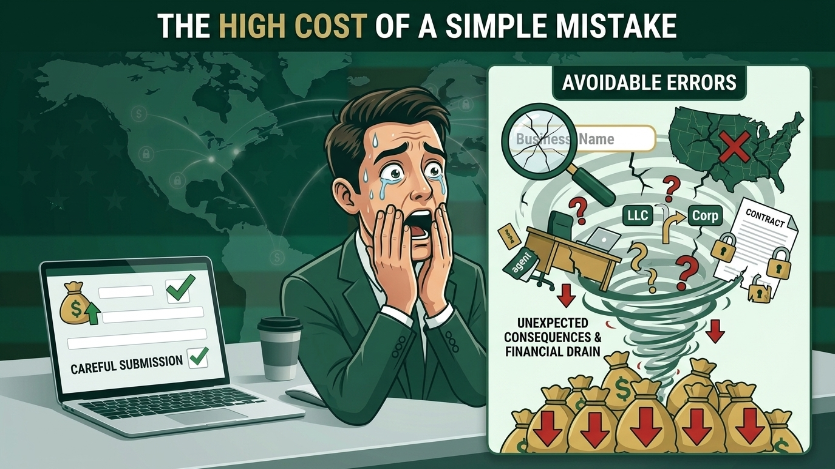
Starting a US Company whether an LLC, C-Corp, or Non-Profit has never been simpler. Online formation services let entrepreneurs from anywhere in the world submit documents in minutes. That convenience, however, creates a new problem: it is easy to make expensive errors that only become obvious months later.
Whether you live outside the United States, run a fully remote business, or simply want to keep costs and compliance under control, these are the five most common mistakes people make when forming a US Company online—and how to sidestep them.
1. Picking the Wrong US State for Your LLC
Many founders automatically choose Delaware or California because those names sound prestigious. In reality, the “best” state depends on your business model, location, and long-term plans.
- Delaware works well for venture-backed startups that expect institutional investors, but it charges a $400 annual franchise tax (and more for larger companies).
- California imposes an $800 annual LLC tax whether the company earns revenue or not—an expensive surprise for lean or early-stage businesses.
- Colorado, Wyoming, and New Mexico frequently offer lower annual fees, stronger privacy protections, and lighter ongoing compliance. For purely online or foreign-owned companies with no physical US presence, Colorado or Wyoming are often the most practical and cost-effective options.
Key takeaway: Match the state to your actual needs rather than following popular opinion. A remote service business or digital product company rarely benefits from Delaware’s corporate prestige, yet it will feel the higher annual costs.
2. Assuming an LLC Is Always the Right Entity Type
The word “LLC” has become almost synonymous with “US company,” but it is not the only option—and it is not always optimal.
- An LLC provides flexibility, pass-through taxation (or no US tax for certain foreign-owned online service businesses), and relatively simple administration. It suits most remote and service-based founders.
- A C Corporation may be better if you plan to raise outside capital, issue stock options, or run a US-based e-commerce operation that needs to retain earnings inside the company.
- An S Corporation is available only to US persons and can reduce self-employment taxes in some situations, but it introduces extra complexity and is irrelevant for most non-residents.
Choosing the wrong structure can limit fundraising options, increase tax friction, or create unnecessary compliance work. Spend time comparing entity types against your ownership structure, revenue model, and growth plans before filing.
3. Underestimating the True Ongoing Costs
Aggressive “$0 LLC” or “$49 formation” ads are common to see online. The advertised price usually covers only the state filing fee. Real-world expenses quickly add up:
- Annual registered agent fees
- State annual reports or franchise taxes
- Virtual mailbox or mail-forwarding services
- EIN application assistance (when needed)
- Bookkeeping, tax preparation, and possible sales-tax registration
- Banking and payment-platform setup costs
These recurring charges can easily double or triple the first-year budget. Before committing to any service, request a complete cost breakdown that includes year-two and year-three expenses. Transparent providers will show you the full picture; those that hide fees rarely deliver good long-term value
4. Ignoring Ongoing Compliance Requirements
Formation is only the first step. Once the LLC exists, you must keep it in good standing. Common requirements include:
- Filing an annual report (or franchise tax return) with the state
- Maintaining a registered agent with a physical US address
- Filing US tax returns (Form 1120, 1065, or information returns such as Form 5472 for foreign-owned single-member LLCs)
- Updating ownership or address changes with the state and IRS
Missing deadlines triggers late fees, penalties, and, in serious cases, administrative dissolution of the company. Dissolution can freeze bank accounts, disrupt Stripe or PayPal access, and create expensive reinstatement work. Set calendar reminders for every filing date or partner with a service that handles compliance on your behalf.
5. Using an Unreliable Business Address
The address you list on formation documents affects banking, tax correspondence, and legal notices. Many founders use a friend’s house, a temporary Airbnb, or a cheap PO Box. These choices frequently cause problems:
- Banks and fintechs reject applications that list residential or non-commercial addresses.
- Important IRS or state mail can be delayed or returned.
- Some payment processors require a verifiable commercial or virtual business address.
A professional virtual business address that scans and forwards mail reliably solves most of these issues. Choose a provider that offers a real street address (not just a PO Box) and consistent mail handling. This small decision often determines whether bank-account and payment-platform applications succeed on the first try.
How to Form Your LLC the Smart Way
Avoiding these five mistakes comes down to preparation:
- Decide on the optimal state based on cost, privacy, and your actual operations.
- Confirm that an LLC (versus a C-Corp or other structure) fits your goals.
- Calculate the full multi-year cost, not just the formation fee.
- Plan for annual reports, tax filings, and registered-agent renewals from day one.
- Secure a professional virtual address before you file.
The United States remains one of the most accessible places in the world for non-residents to form a legitimate company. Online services like Crosborda make the process fast, and our team oversees the process carefully to avoid creating bigger problems later. Before proceeding to register a US company, take the time to evaluate state choice, entity type, true costs, compliance obligations, and address requirements. Doing so dramatically increases the odds that your US LLC becomes a durable asset rather than an expensive headache.
When you are ready to move forward with clear information and realistic expectations, the process itself is straightforward—and far less risky.