
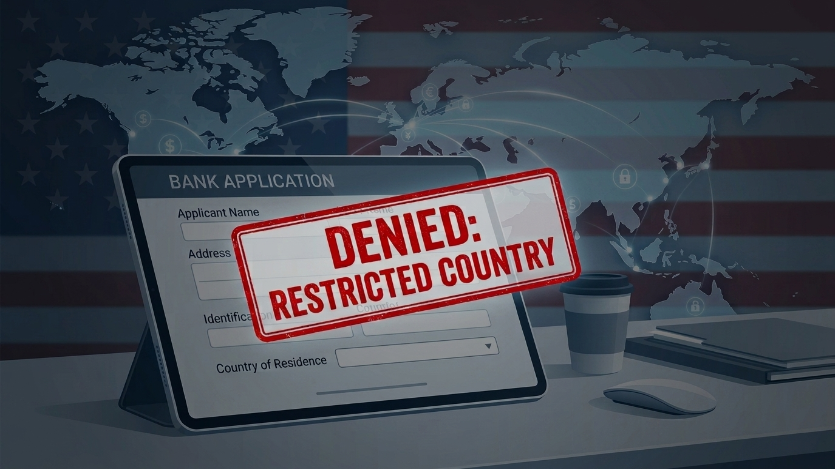
Many international entrepreneurs form a US LLC to gain credibility, access the American market, and streamline operations. One of the biggest expected benefits is opening a US business bank account. For people from certain countries, however, that step is often difficult or impossible.
Here’s a clear look at why restrictions exist, which countries are commonly affected, how banks evaluate citizenship versus residency, and what practical options remain.
Why US Banks Restrict Certain Nationalities and Residencies
US banks and fintechs must follow strict compliance rules. The main drivers of restrictions are:
- US sanctions: Accounts for citizens or residents of sanctioned countries risk violating federal law. Commonly affected nations include Iran, North Korea, Syria, and Cuba.
- Anti-money laundering (AML) rules: Banks must verify the source of funds and avoid high-risk jurisdictions for money laundering or fraud. Countries frequently flagged include Nigeria, Pakistan, and Venezuela.
- Geopolitical and economic risk: Unstable regions, conflict zones, or countries with elevated fraud risk often appear on internal ban lists. Examples sometimes include Lebanon, parts of Ukraine, Palestine, and others.
Every provider maintains its own prohibited-country list. Mercury and Relay, two popular options for remote US business accounts, publish different lists. A nationality or residency blocked by one may be acceptable to another. Lists also change without notice, so always verify the current policy before applying.
Countries Commonly Facing Restrictions
As of mid-2026, citizens or residents of the following places frequently encounter barriers (this is not exhaustive and varies by bank):
- Russia
- Lebanon
- Ukraine
- Bosnia and Herzegovina
- Albania
- Many countries across the Middle East, Africa, and parts of Asia
Active war zones and fully sanctioned nations are almost always restricted across providers. Citizens of countries such as Turkey or the UAE may succeed with some banks and fail with others. Always check the specific provider’s current prohibited-countries page (for example, Mercury’s and Relay’s support articles).
Citizenship vs. Residency: Both Matter
Banks typically review both:
- Citizenship: Holding a passport from a restricted country can lead to denial even if you live elsewhere. A Russian citizen residing in Germany may still face rejection.
- Residency: Living in a restricted country can trigger risk flags even if your passport is from an unrestricted nation. A German citizen living in Lebanon may encounter the same hurdles.
This dual check makes it essential to confirm eligibility based on both your passport and your current address.
Limited Workarounds
There are no guaranteed ways around US legal and compliance requirements. A few approaches sometimes help, depending on the situation:
- Try traditional banks or alternative fintechs — Online-first providers like Mercury and Relay often apply stricter remote-onboarding rules. Some brick-and-mortar banks may be more flexible, though they usually require an in-person visit.
- Partner with a co-founder from a non-restricted country — A trusted partner who is not restricted may open the account for the LLC. Note that certain providers (including Relay) will still decline if any owner is from a prohibited country.
- Explore non-US banking and payment solutions that still support a US LLC — These do not replace a true US bank account but can enable receiving payments.
Receiving Payments Without a Traditional US Bank Account
Even without an account at a US-chartered bank or major fintech, many founders still collect US and international payments:
- Wise Business provides US routing and account numbers that work with platforms such as Stripe, plus multi-currency support.
- Payoneer and Airwallex are additional options that frequently integrate with Stripe and other payment processors.
A US LLC with an EIN is typically still required to open these accounts. This combination can give you functional payment rails while you operate under a US entity.
Practical tip: Avoid applying blindly. A rejected application can complicate future attempts. Confirm eligibility with the provider first, or work with an advisor who can review your citizenship and residency against current bank policies.
Is a US LLC Still Worth Forming Without a Full US Bank Account?
For many founders the answer is yes, provided the primary goals are credibility, market access, or the ability to use US payment infrastructure via alternatives. A US LLC still supplies:
- A legitimate US entity structure
- An EIN that many platforms require
- The option to use Wise, Payoneer, Airwallex, or similar services for Stripe and other processors
If seamless access to mainstream US business banking is the main reason for incorporation, restrictions may outweigh the benefits. For others, the combination of a US company plus alternative payment accounts remains a practical path.
Bottom Line
Forming a US LLC remains attractive for global entrepreneurs, but banking access is not universal. Sanctions, AML rules, and risk policies create real barriers for citizens and residents of certain countries. Options such as alternative payment platforms can mitigate the problem, yet they do not fully replace a conventional US business bank account.
Policies change, and every bank decides independently. Before investing time or money, check the current prohibited-country lists of your target providers and evaluate whether a US entity still aligns with your specific goals.
Note: Information reflects publicly available guidance as of July 2026. Always verify the latest policies directly with the financial institution.